~Culture
Hummingbirds
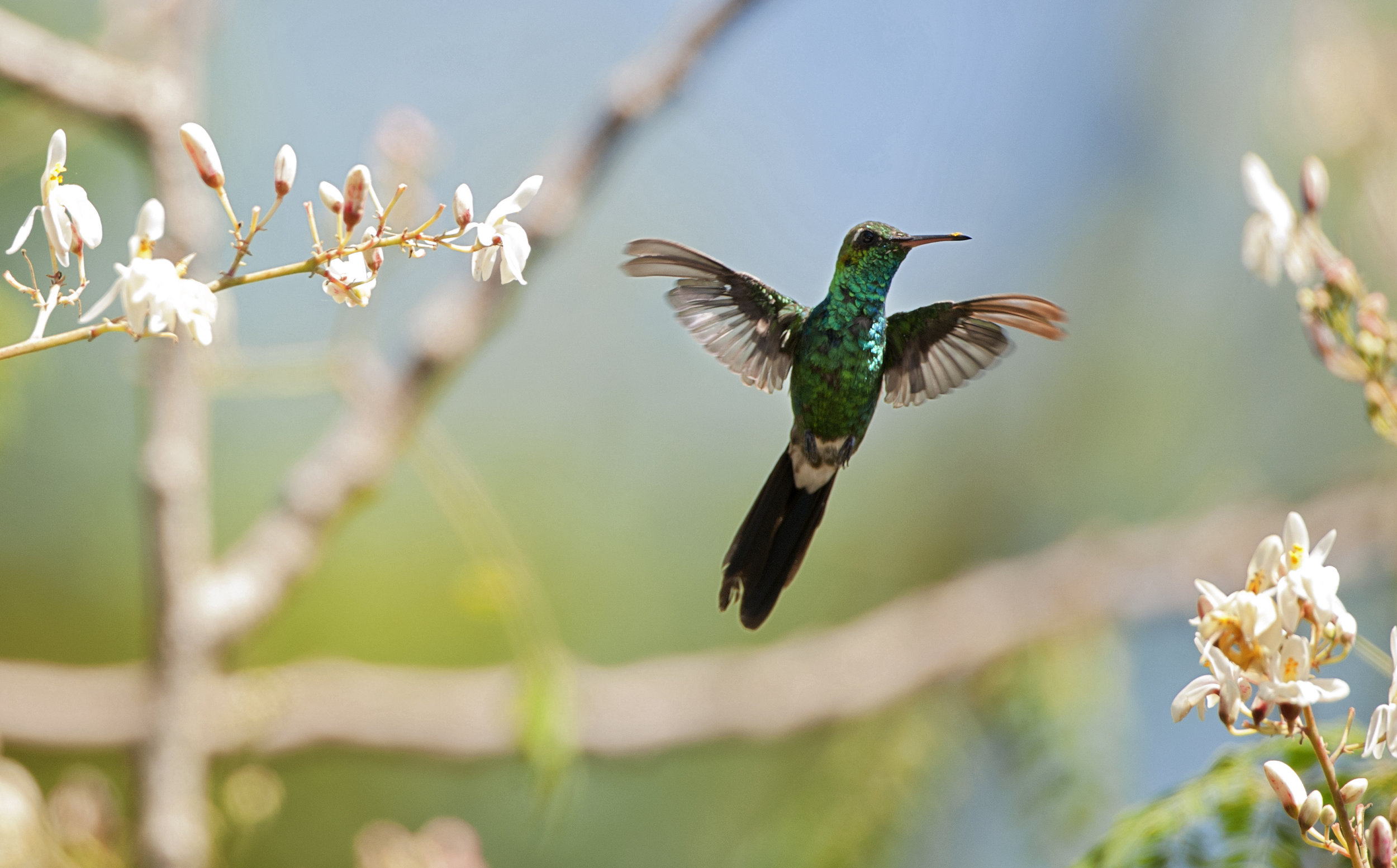
Cuban Emerald Hummingbird
Their name comes from the fact that they flap their wings so fast (about 80 times per second) that they make a humming noise. Hummingbirds can fly right, left, up, down, backwards, and even upside down, making them one of the most admired species of bird. They are also able to hover by flapping their wings in a figure-8 pattern. They have a specialized long and tapered bill that is used to obtain nectar from the center of long, tubular flowers. The hummingbird’s feet are used for perching only, and are not used for hopping or walking.
Hummingbirds are the world's second largest family of birds with an estimated 338 species. Distinct characteristics make hummingbirds one of the most recognizable birds on the planet, despite the fact that they are only in North, South, Central America, and the islands of the Caribbean’s, they are quite familiar around the world.
In spite of their worldly popularity most people are unaware that thirty-four (34) species, or nearly ten per cent, are threatened with extinction, according to an analysis by BirdLife International. Fortunately, Majestic Cuban Emerald Hummingbird, pictured above is not currently part of the endangered species list. The Cuban Emerald Hummingbirds are indigenous to Cuba, Bahamas, and Turks and Caicos Islands.
Physical Characteristics:
The Emerald is a smallish dark-green hummingbird with colorful iridescent feathers.
The male averages 4 - 4.5 inches in length weighing about 0.18 oz has a short bill with a black upper beak and a red lower beak with a black tip. The plumage above is dark green and the plumage below is glossy green with a hint of metallic blue. The under tail feathers are white and the tail is deeply forked.
The females measure 3.7 - 4.1 inches and weighs about 0.12 oz. resembles the male for the most part, but her plumage below is brownish-grey with green flanks. Her tail is slightly less pitched, both sexes have a whitish spot behind the eye.
Social Habitat:
They live in solitary in all aspects of life other than breeding; and the male's only involvement in the reproductive process is the actual mating with the female. They neither live nor migrate in flocks; and there is no pair bond for this species. Males court females by flying in a u-shaped pattern in front of them. He will separate from the female immediately after copulation. One male may mate with several females. In all likelihood, the female will also mate with several males. The males do not participate in choosing the nest location, building the nest, or raising the chicks.
The female Cuban Emerald Hummingbird is responsible for building a small cup-shaped nest out of green moss and lines it with other soft plant fibers, and strengthens the structure with spider webbing. The nest is typically found on a twig 1-3 m high in bush.
The average clutch consists of two white eggs, which she incubates alone, while the male defends his territory and the flowers he feeds on. The young are born blind, immobile and without any down.
The female alone protects and feeds the chicks with regurgitated food (mostly partially digested insects since nectar is an insufficient source of protein for the growing chicks). The female pushes the food down the chicks' throats with her long bill directly into their stomachs.
As is the case with other hummingbird species, the chicks are brooded only the first week or two, and left alone even on cooler nights after about 12 days - probably due to the small nest size. The chicks leave the nest when they are about 20 days old.
Diet:
The hummingbird’s fast breathing rate, fast heartbeat and high body temperature require that they eat often. They also require an enormous amount of food each day. Hummingbirds have a long tongue, which they use to lick their food at a rate of up to 13 licks per second.
Threats
Historically hummingbirds were killed for their feathers, today they face different but equally devastating threats.
Habitat loss and destruction are the hummingbird’s main threats. As hummingbirds are often specially adapted to each unique habitat, each species of hummingbird currently listed as vulnerable or endangered on the ICUN (International Union for Conservation of Nature and Natural Resources) are all threatened due to habitat destruction and loss.
Also, the earth's changing temperatures due to climate change are affecting hummingbird migratory patterns, causing different species to be spotted in locations well outside their normal range, where it may be harder for them to find food.
Reasons For Hope
Hummingbirds in the U.S. and around the world have the benefit of being garden and backyard favorites. Many people put out hummingbird feeders or grow flowers that attract hummingbirds in the warmer months that allow these birds to refuel during their long migratory journeys. What's in sight is often in mind, and many fans of hummingbirds are doing what they can to keep every backyard, park and garden a friendly place for these beautiful birds, hopefully this encourages you to do your part as well, for our little feathered friends. To learn more about saving the hummingbirds visit http://www.hummingbirdsociety.org.
By U. Krazt