
AFRICAN CEREMONIAL MASK
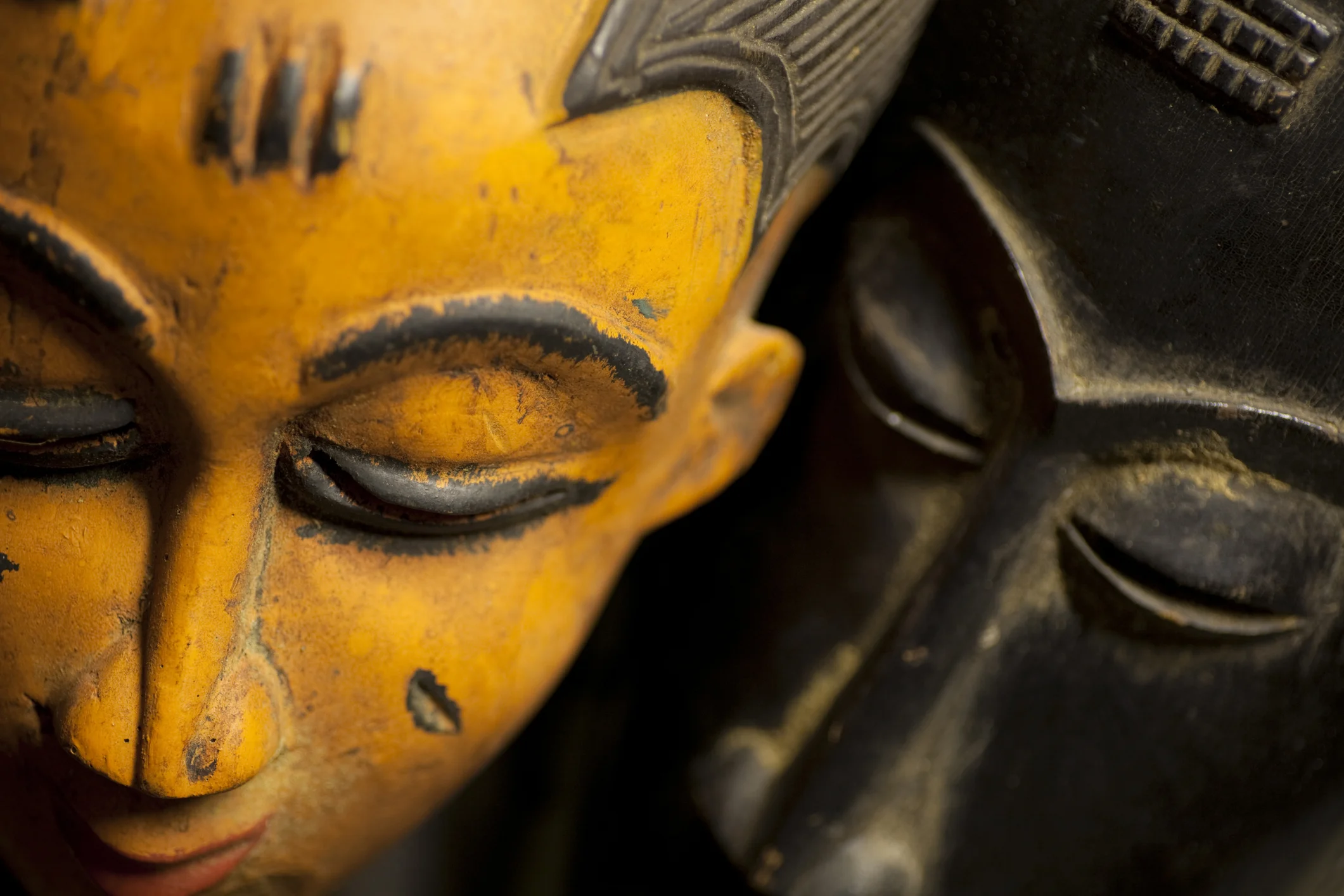
Many countries and cultures wear ceremonial mask, however, the mask from the African cultural's appear to have a universal appeal being the most adorn, eccentric and sought after mask of all cultures. These masks are famous for a variety of reasons, from spiritual rituals, entertainment, social control, and education. The elaborate decorations can be as simple as some form of coloring, to beads, shells and as elaborate as skin, feathers, and gold. These ornate features are different for each tribe, region, and country.
Artists
• The African Mask is a physical representation of a spiritual design, crafted by highly skilled artist who would have undergone training lasting many years. Because they are used in religious and social events to represent the spirits of ancestors or to control the good and evil forces in the village an in-depth knowledge of traditional carving techniques, use of materials and a grounding in the social, religious and cultural aspects of the tribal village has to be the basis of his education. The craft of mask making is generally handed down through many generations although it is not unlikely that the skills can be learned as an apprentice in the workshop from a master carver/artisan. The artist holds a respected position in African tribal society. It is his job to provide the various masks and sculptures for use in ritual ceremonies. His work is valued for its spiritual, rather than its aesthetic qualities. The masks are designed based on the predetermined criteria depending upon the ceremonial function and gender of the person wearing it. The design attributes of the female mask is primarily for beauty and grace, while on the other hand male masks are design for hunting, playing and warding off evil spirits.
Materials
• African masks are made from different materials: wood, bronze, brass, copper, ivory, terracotta and glazed pottery, raffia and textiles, often decorated with cowrie shells, colored beads, bone, animal skins, and vegetable fiber.
Due to the abundance of trees and the belief that the tree has a spiritual soul and its wood is the most natural home for the spirit explains why the majority of masks and sculptures, are made of wood. Before any tree is cut down, a sacrifice may be offered as a mark of respect to the spirit of the tree requesting its permission for the carving. Its life is governed by the same natural and supernatural forces that inspire the artist and his community. This type of ritual is common to many cultures that have a close spiritual bond with nature.
Patterns
• Bold pattern, either painted or carved, is a powerful and expressive element in African mask design. Most patterns tend to be geometrical and symmetrical and are used in a variety of ways.
Different geometric patterns are sometimes used to distinguish between male and female masks. Square and triangular checkerboard grids are often carved to decorate sections of a design. A variety of complex braided hairstyles adorn the top of the head.
Some patterns are often used as a form of coded information. Parallel, zigzag, cruciform, curved, and spiral lines, representing scarification marks or tattoos, are frequently used to adorn the planes of the mask face. These can denote social status or have magical or religious powers.
Interlacing crosses and geometric forms are often seen as details on African masks. With the spread of the Moslem faith in Africa, some of these designs show an influence of the decorative ideals of Islamic Art.
Styles
• Two main forces that influence the style of an African tribal mask:
Traditional style that is dictated by the social and religious beliefs of the village and secondly, the individual vision of the carver.
The African tribal artists does not try to create a perfect representation of their subject although some realistic portraits are made, others celebrate more abstract qualities like nobility, beauty, courage, mischief and humor. They create an idealized version, emphasizing those elements that they consider most important: Formal symmetrical arrangements of line, shape, and form in figures and masks evoke integrity and dignity. Skilled artisanship, fine detail, and quality of finish are of great importance to the African tribal artist. Highly polished surfaces, which represent a youthful healthy skin, reflect the idea of beauty and virtue, while rough dirty surfaces suggest fear and evil. Many African carvings portray the idealized human figure in its prime, brimming with health, strength, and celebrating fertility or virility. African masks take on many forms. They can be oval, circular, rectangular, elongated, heart-shaped, animal, or human, or any combination of these. Art Appreciation is the knowledge and understanding of the universal and timeless qualities that identify all great art. The more you appreciate and understand the art of different eras, movements, styles and techniques, the better you can develop, evaluate, and improve your own artwork.